
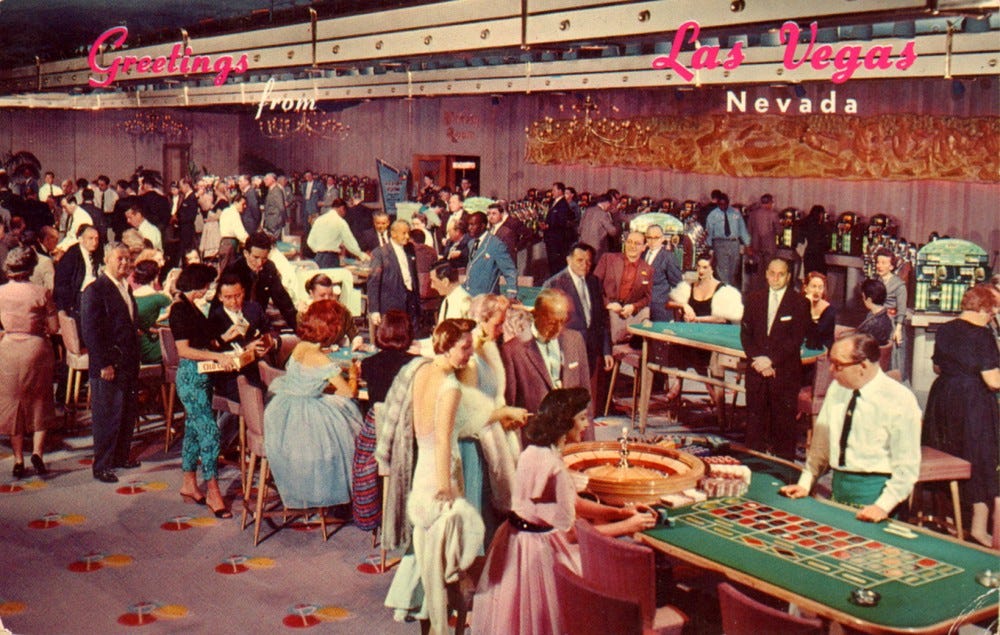
A casino is the most carefully designed room you will ever stand in. The drinks are free on the gambling floor. There are no clocks anywhere. There are no windows, and no daylight to anchor you to the world outside. The TVs upstairs play training videos on how to play the games, so you don’t stay in your hotel room. By the time you have been on the floor for three hours, you don’t know what time it is, you don’t know what you have spent, and you have been having a great time the whole way down.
None of this is accidental. Every element is engineered to lower your executive function. Free drinks dull judgment. No clocks remove the prompt to leave. No windows remove the reminder that a real day is happening outside the building. The shining lights, the chatter, the dealers who treat you like a high roller — all of it works together to disorient you, on purpose, because a disoriented person stays at the table, chasing the excitement.
I grew up around Las Vegas in an era when the manipulation was the whole business. Some of today’s casinos have dialed elements of it back, but many still operate the way they did when I was a kid, and the underlying architecture has not changed even where the surface has softened. The room is still designed to keep you in it.
I have walked through casino lobbies at six in the morning, on my way out to go rock climbing, and seen kids asleep on the carpet because their parents had lost track of time. I have walked past people on payphones explaining to someone they love why they have spent everything. The hotels have special arrangements with credit cards because cash advances to keep gambling routinely max out credit limits, making it impossible to pay the hotel charges.
Most people assume the casino takes their money on the odds. It doesn’t. It takes their money on the iterations.
A slot machine advertised at 98% payback returns ninety-eight dollars on every hundred you put in — over a very large number of trials. Inside a single evening, you do not get a very large number of trials. You get streaks. The streaks cancel out in the long run, but you do not live in the long run. You live in tonight, with a fixed bankroll. When the streak goes against you, you bust out, and the trial ends. The casino has infinite money and infinite patience. You do not. That is the asymmetry. They never bust out. You eventually do.
When I talk about structure, this is the math. A casino is built explicitly on it — every game’s odds, every payout percentage, every comp threshold. But every structure is the math through which we operate and process information, whether we have named it or not. Math is the structure. The casino has just made the structure visible by building a room around it.
In graduate school, my friend and I drove up from Tucson to visit family in Las Vegas. We were starving students. We met up with some guys who had been watching the Lakers and the Celtics, and one of them said, let’s go play craps and make a lot of noise. We pulled up to a Caesars Palace table with a twenty-five-dollar minimum, looked at each other, and walked back out. Then one of the guys said: let’s go across the street to Little Caesars.
Little Caesars had a fifty-cent crap table.
My friend and I each put forty dollars on the table. We agreed: when the forty dollars are gone, we leave. We played for four raucous hours, we yelled, we acted like high rollers on a fifty-cent table, we made bets for the boys, we had one of the funnest nights of our lives. Eventually the forty dollars were gone. We left.
The architecture did not change between Caesars Palace and Little Caesars. The free drinks were still free. The clocks were still gone. What changed was that we walked in knowing exactly what we were doing. We were buying an evening of entertainment for forty dollars apiece. We were not trying to make money, we were not trying to recoup anything, we had no interest in the math of the house. We had named our intent before we entered the room, and once intent was named, the structure lost its grip. When the money was gone, the evening was over.
Same architecture. Same math. Different intent. Once intent is named, the structure loses its grip.
The casino is the easiest version of this story to see, because the architecture is so visible. The clocks are obviously missing. The drinks are obviously free. But the same structure operates everywhere you look, once you know what to look for: apps designed to hold attention, feeds designed to confirm what you already believe, environments designed to make a story feel like a fact. They work for the same reason the casino works. You don’t notice the design, and you haven’t named what you are there for.
The first move of any decision practice is learning to see the room you’re standing in.